

CG Structure · 2025
In this section20 topics
- Board Composition9 items
- Board of Directors1 item
- Board Meetings & Remuneration6 items
- Balance of Power Between the Board and Management3 items
- Board Roles, Duties and Charter4 items
- Other Board Governance Matters1 item
- Subcommittees — Overview1 item
- Audit Committee5 items
- Executive Committee5 items
- Other Subcommittees1 item
- Executives2 items
- Executive Remuneration3 items
- Remuneration Policy2 items
- Employees2 items
- Provident Fund4 items
- Policy for Employees Not in the Provident Fund5 items
- Auditors and Audit Fees4 items
- Company Secretary and Other Assigned Persons4 items
- Investor Relations Contact2 items
- Representatives in Thailand (Foreign Companies)1 item
Board Composition
Board Composition — Introduction
The Board of Directors is composed of directors who possess knowledge, capabilities, and experience across a wide range of fields, both in the business sector and in other areas that are beneficial to the Board’s operations and the Company’s business activities. The Board must comprise a sufficient number of directors to effectively oversee the Company’s business, namely not fewer than five (5) directors. At least one-third (1/3) of the total number of directors, and not fewer than three (3) directors, must be independent directors. In addition, there must be at least one (1) non-executive director with experience in accounting and finance. The Board is responsible for formulating the overall policies of the Company, considering key management matters, and overseeing and monitoring the Company’s operations to ensure that they are carried out in accordance with the established plans in a correct, efficient, and transparent manner, taking into account the Company’s vision, mission, principles of good corporate governance, and business ethics.
As of 30 September 2025, the Company’s Board of Directors consisted of eleven (11) members, comprising:
The Chairman of the Board is an independent director and does not hold the same position as the Chairman of the Executive Committee or the Chief Executive Officer, in order to ensure appropriate checks and balances of authority between the Board of Directors and management. The Board has clearly separated the roles, duties, and responsibilities of the Board from those of management to balance power and prevent any individual from having absolute decision-making authority. The scope of authority and responsibilities of the Chairman of the Board, the Chairman of the Executive Committee, and the Chief Executive Officer are specified in Section 6.1.1, “Independence of the Board of Directors and Management,” of this report.
The number of independent directors of the Company complies with the criteria of the Securities and Exchange Commission (SEC), which require listed companies to have independent directors representing at least one-third (1/3) of the total number of directors, but not fewer than three (3) persons. Independent directors are able to express opinions on operations under established policies independently, without domination or restriction of their roles in Board meetings. Three (3) independent directors also serve as members of the Company’s Audit Committee.
The non-executive directors possess work experience relevant to the core businesses of the Group or have extensive knowledge in the management of large organizations that is beneficial to the Company’s management, such as expertise in accounting and finance, real estate, and investment.
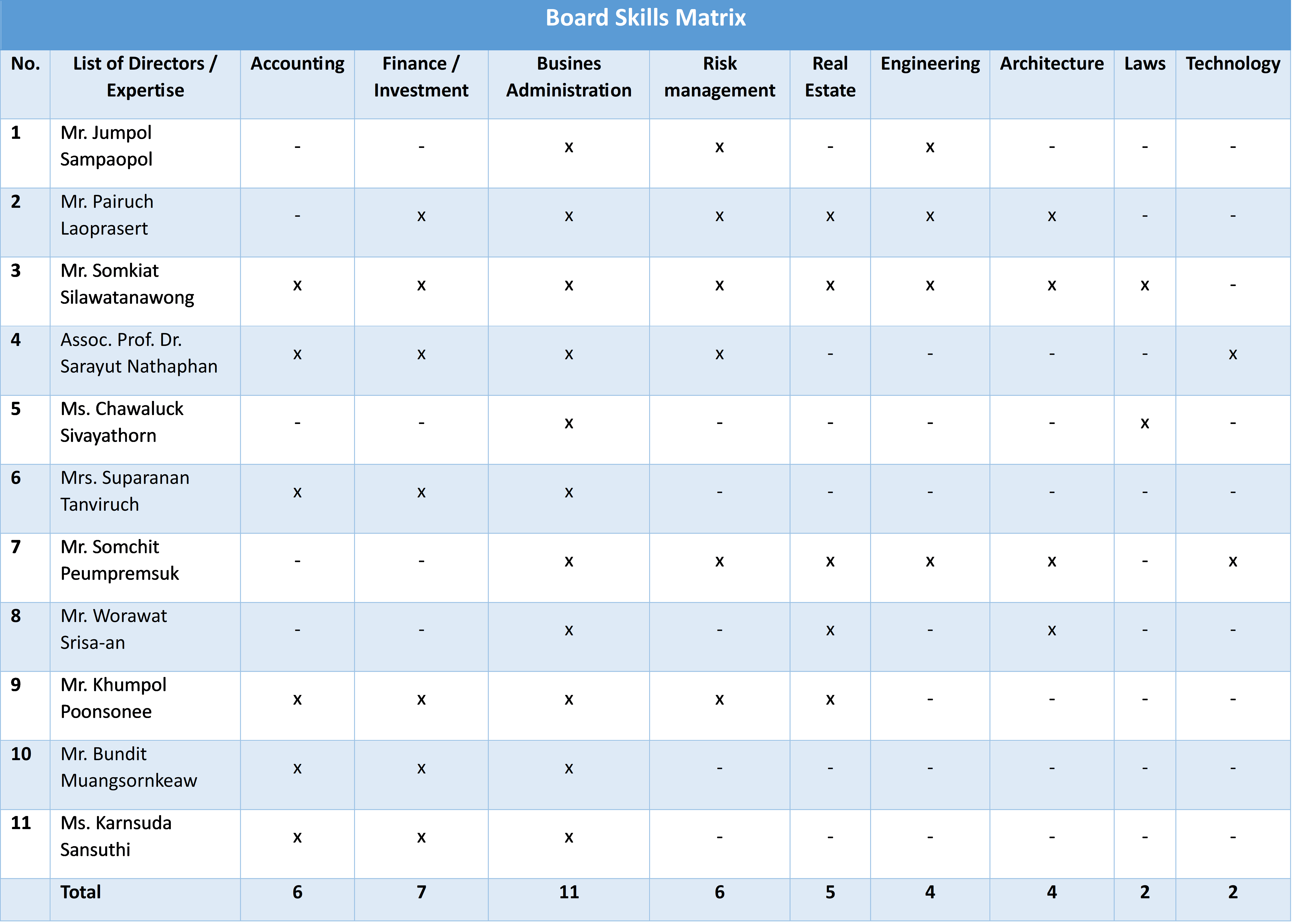
The Company places significant importance on the composition and qualifications of its Board of Directors, ensuring diversity in terms of skills, knowledge, experience, areas of expertise, and professional competencies that support the Company’s business strategies. A Board Skills Matrix has been prepared to serve as information for the recruitment of individuals to serve as directors in relevant fields or to complement the Board’s work, as well as to enhance and develop directors’ knowledge and skills that are beneficial to the Company. Furthermore, there are no limitations on other forms of diversity, such as gender, age, race, nationality, religion, or any other differences. At present, the Company has established a framework for promoting diversity in the structure of the Board of Directors as follows.
Goals | Key Performance Indicators | Feasible |
1. Number of independent directors | At least one-third of all directors, but not less than 3 persons | 4 persons |
2. Directors with knowledge of the company's business | At least 1 non-executive director with the requisite knowledge. | 1 person |
3. Directors with knowledge in accounting and finance | At least 1 director who is not an executive director and possesses the relevant knowledge. | 2 persons |
4. Number of female directors | At least 2 persons | 3 persons |
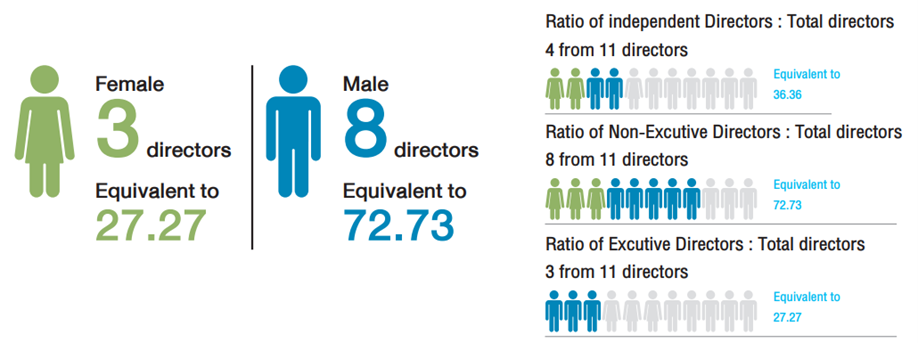
Total Number of Directors
11
Male Directors
8
Female Directors
3
Independent Directors
4
Non-executive Directors
8
Non-executive Directors Who Are Not Independent
4
Executive Directors
3
Total Board Meetings Held
4
Board of Directors
Directors
| Title | Title — Please Specify | First Name | Last Name | Gender | Year of Birth | Nationality | Resident in Thailand? | Position | Executive or Non-executive | Independent Director? | Director Type | Appointment Date | Authorised to Sign? | Related to Another Director or Executive? | Any Legal Violation in the Past 5 Years? | Highest Education | Field of Study | Field of Study — Please Specify | Skills & Expertise | Director Training | Attended Director Training? | Director Accreditation Program (DAP)? | Director Certification Program (DCP)? | Board Meetings Held | Board Meetings Attended | AGMs Held | AGMs Attended | Meeting Allowance (Baht) | Other Remuneration (Baht) | Total Remuneration (Baht) | Non-monetary Remuneration | Shares Held | Shareholding (%) | Shares Held by Related Persons (s.59) | Shareholding by Related Persons (s.59, %) |
|---|---|---|---|---|---|---|---|---|---|---|---|---|---|---|---|---|---|---|---|---|---|---|---|---|---|---|---|---|---|---|---|---|---|---|---|
| Mr. | JUMPOL | SUMPAOPOL | M | 1,953 | 643 · Description: Thailand | Y | Chairman of the board | Non-executive | Y | Continuing director (Full term of directorship and being re-appointed as a director) | 2017-02-27T00:00 | N | N | N | Bachelor's degree | Engineering | 159 · Description: Engineering · 165 · Description: Risk Management · 158 · Description: Corporate Management | 1731 · Year: 2012 · Description: Director Certification Program (DCP) · 1736 · Year: 2024 · Description: Role of the Chairman Program (RCP) · 2020 · Description: The Role of the Board in IT Governance · 2025 · Description: Chairman Forum 2025 “Building Future-Ready Organizations Through Chairman” | Y | N | Y | 4 | 4 | 1 | 1 | 100,000 | 240,000 | 340,000 | 0 | 0 | 0 | ||||
| Mr. | PAIRUCH | LAOPRASERT | M | 1,963 | 643 · Description: Thailand | Y | Vice Chairman | Executive | Continuing director (Full term of directorship and being re-appointed as a director) | 2016-09-08T00:00 | Y | N | N | Master's degree | Business Administration | 158 · Description: Corporate Management · 159 · Description: Engineering · 160 · Description: Architecture · 144 · Description: Finance · 165 · Description: Risk Management | 1730 · Year: 2017 · Description: Director Accreditation Program (DAP) · 2025 · Description: Boardroom Excellence (Class of 2): A Key to Corporate Success, organized by the SET and IOD | Y | Y | N | 4 | 4 | 1 | 1 | 80,000 | 180,000 | 260,000 | 0 | 52,643,250 | 8.73 | |||||
| Mr. | SOMKIAT | SILAWATANAWONG | M | 1,964 | 643 · Description: Thailand | Y | Vice Chairman | Executive | Existing director | 2016-09-08T00:00 | Y | N | N | Doctoral degree | Engineering | 141 · Description: Law · 159 · Description: Engineering · 130 · Description: Property Development · 144 · Description: Finance · 160 · Description: Architecture | 1730 · Year: 2017 · Description: Director Accreditation Program (DAP) · 1731 · Year: 2018 · Description: Director Certification Program (DCP) · 2025 · Description: Training on “Registration of Specialist Examiners for Testing the Knowledge of Applicants for Professional Engineering Licenses at the Associate Engineer and Professional Engineer Levels,” · 2025 · Description: Seminar on “Criteria and Guidelines for Evaluating Professional Engineering Practice at the Associate Engineer, Professional Engineer, and Senior Professional Engineer Levels in the Civil Engineerin · 2025 · Description: Seminar on “Guidelines for Inspection and Evaluation Based on the Updated Professional Competency Statement Form,” organized by the Council of Engineers | Y | Y | Y | 4 | 4 | 1 | 1 | 80,000 | 180,000 | 260,000 | 0 | 66,663,500 | 11.06 | 543,884 | 0.09 | |||
| Mr. | KHUMPOL | POONSONEE | M | 1,971 | 643 · Description: Thailand | Y | Director | Non-executive | N | Existing director | 2016-08-11T00:00 | Y | N | N | Master's degree | Business Administration | 143 · Description: Accounting · 144 · Description: Finance · 158 · Description: Corporate Management · 130 · Description: Property Development · 165 · Description: Risk Management | 1730 · Year: 2011 · Description: Director Accreditation Program (DAP) · 1731 · Year: 2014 · Description: Director Certification Program (DCP) · 2014 · Description: Risk Management Committee Program (RMP) · 2015 · Description: Company Secretary Program (CSP) · 2025 · Description: ESG in Action - ESG Global Regulations and Reporting & ESG and Impact on Financial Information | Y | Y | Y | 4 | 4 | 1 | 1 | 80,000 | 180,000 | 260,000 | 0 | 0 | 0 | ||||
| Mr. | WORAWAT | SRISA-AN | M | 1,972 | 643 · Description: Thailand | Y | Director | Non-executive | N | Existing director | 2016-08-11T00:00 | Y | N | N | Master's degree | other | Urban Development Planning | 130 · Description: Property Development · 158 · Description: Corporate Management · 160 · Description: Architecture | 1728 · Year: 2019 · Description: Board Nomination and Compensation Program (BNCP) · 1731 · Year: 2014 · Description: Director Certification Program (DCP) · 1734 · Year: 2015 · Description: Financial Statements for Directors (FSD) · 1739 · Year: 2014 · Description: Successful Formulation & Execution of Strategy (SFE) · 2024 · Description: Refreshment Training Program (RFP 14/2024) · 2025 · Description: Executive Development Course, Royal Thai Police (Combined Course) | Y | N | Y | 4 | 4 | 1 | 1 | 80,000 | 180,000 | 260,000 | 0 | 0 | 0 | |||
| Mr. | BUNDIT | MUANGSORNKEAW | M | 1,969 | 643 · Description: Thailand | Y | Director | Non-executive | N | Continuing director (Full term of directorship and being re-appointed as a director) | 2016-08-11T00:00 | Y | N | N | Master's degree | Business Administration | 143 · Description: Accounting · 144 · Description: Finance · 158 · Description: Corporate Management | 1731 · Year: 2018 · Description: Director Certification Program (DCP) · 1739 · Year: 2021 · Description: Successful Formulation & Execution of Strategy (SFE) · 1735 · Year: 2018 · Description: Risk Management Program for Corporate Leaders (RCL) · 2021 · Description: Board Reporting Program (BRP) · 2025 · Description: TLCA CFO Professional Development Program No. 8/2025: "Three Lines of Defense Model and the CFO's Work" · 2025 · Description: TLCA CFO Professional Development Program No. 7/2025: "Financial Reporting Standards on Sustainability Disclosure: IFRS S1 / IFRS S2" · 2025 · Description: TLCA CFO Professional Development Program No. 5/2025: "Accounting System Planning" · 2025 · Description: Seminar on "TFRS16 2025: Principles, Issues, and Solutions" · 2025 · Description: Seminar on "Getting to Know FTSE Russell ESG Scores: Similarities and/or Differences from Other Sustainability Indices (SET ESG Rating, DJSI, MSCI)" · 2025 · Description: Seminar on "Blueprint for Growth: From Strategy to Business Plan and Unlocking Value" · 2025 · Description: TLCA CFO Professional Development Program No. 4/2025: "Financial Reporting Standards Related to Climate Change (Climate-Related Risks)" · 2025 · Description: TLCA CFO Professional Development Program No. 3/2025: "Update on Accounting Standards Coming into Effect (IFRS 18, IFRS 19)" · 2025 · Description: TLCA CFO Professional Development Program No. 2/2025: "Digital Asset: Utility" Token" · 2025 · Description: Seminar on "TFRS 18 (Principle and Practice)" · 2025 · Description: TLCA CFO Professional Development Program No. 1/2025 "Economic Update for CFOs" · 2025 · Description: Seminar on "Governance and Risk Management for Using AI" · 2025 · Description: Seminar on "Consolidated Financial Statements: Principles, Preparation, and Issues · 2025 · Description: Seminar on "Green Reporting" · 2025 · Description: Seminar on "Transforming One Report with IFRS S Integration: Impacts and Preparation for Listed Companies" · 2025 · Description: Seminar on "Improving the Criteria for Material Transactions and Related Party Transactions for Listed Companies" | Y | N | Y | 4 | 4 | 1 | 1 | 80,000 | 180,000 | 260,000 | 0 | 0 | 0 | ||||
| Mr. | SOMCHIT | PEUMPREMSUK | M | 1,964 | 643 · Description: Thailand | Y | Director | Executive | Existing director | 2016-09-08T00:00 | Y | Y | N | Bachelor's degree | Engineering | 159 · Description: Engineering · 158 · Description: Corporate Management · 165 · Description: Risk Management · 160 · Description: Architecture · 150 · Description: IT Management | 1732 · Year: 2022 · Description: Director Leadership Certification Program (DLCP) · 1735 · Year: 2019 · Description: Risk Management Program for Corporate Leaders (RCL) · 1731 · Year: 2017 · Description: Director Certification Program (DCP) · 2025 · Description: Seminar on “Lessons Learned from ESG Risk Management”, organized by TLCA · 2025 · Description: AI Transformation: Transforming Organizations with AI, organized by STI Academy · 2025 · Description: Anti-Corruption Practical Guide (ACPG) Program, Class of 73, organized by Thai CAC · 2025 · Description: Director’s Briefing 12/2025: From Compliance to Competitiveness: Climate Governance as a Source of Strategic Advantage, organized by IOD | Y | N | Y | 4 | 4 | 1 | 1 | 80,000 | 180,000 | 260,000 | 0 | 50,928,300 | 8.45 | |||||
| Ms. | CHAWALUCK | SIVAYATHORN | F | 1,977 | 643 · Description: Thailand | Y | Director | Non-executive | Y | Existing director | 2017-02-27T00:00 | N | N | N | Master's degree | other | LL.M. in International Business Law | 141 · Description: Law · 158 · Description: Corporate Management | 1727 · Year: 2019 · Description: Advanced Audit Committee Program (AACP) · 1730 · Year: 2018 · Description: Director Accreditation Program (DAP) · 2025 · Description: Hot Issue for Directors Program (Class of 2): Enhancing the role of the Audit Committee to promote transparency and build trust among stakeholders, organized by the SET and IOD | Y | Y | N | 4 | 4 | 1 | 1 | 80,000 | 180,000 | 260,000 | 0 | 0 | 0 | |||
| other | Asso. Professor Dr. | SARAYUT | NATHAPHAN | M | 1,971 | 643 · Description: Thailand | Y | Director | Non-executive | Y | Existing director | 2017-08-11T00:00 | N | N | N | Doctoral degree | Finance | 144 · Description: Finance · 158 · Description: Corporate Management · 165 · Description: Risk Management · 143 · Description: Accounting · 150 · Description: IT Management | 1727 · Year: 2019 · Description: Advanced Audit Committee Program (AACP) · 1730 · Year: 2011 · Description: Director Accreditation Program (DAP) · 1731 · Year: 2014 · Description: Director Certification Program (DCP) · 2025 · Description: Hot Issue for Directors Program (Class of 2): Enhancing the role of the Audit Committee to promote transparency and build trust among stakeholders, organized by the SET and IOD | Y | Y | Y | 4 | 4 | 1 | 1 | 80,000 | 180,000 | 260,000 | 0 | 0 | 0 | |||
| Mrs. | SUPARANAN | TANVIRUCH | F | 1,966 | 643 · Description: Thailand | Y | Director | Non-executive | Y | Continuing director (Full term of directorship and being re-appointed as a director) | 2019-04-23T00:00 | N | N | N | Master's degree | Accounting | 144 · Description: Finance · 143 · Description: Accounting · 158 · Description: Corporate Management | 1731 · Year: 2016 · Description: Director Certification Program (DCP) · 2025 · Description: Audit Committee Forum 2025: “In the Winds of Change: How Will You Adapt When the World Changes?” organized by EY Office Company Limited | Y | N | Y | 4 | 4 | 1 | 1 | 80,000 | 180,000 | 260,000 | 0 | 0 | 0 | ||||
| Mrs. | KARNSUDA | SANSUTHI | F | 1,969 | 643 · Description: Thailand | Y | Director | Non-executive | N | Existing director | 2023-01-26T00:00 | Y | N | N | Master's degree | Business Administration | 143 · Description: Accounting · 144 · Description: Finance · 158 · Description: Corporate Management | 1727 · Year: 2020 · Description: Advanced Audit Committee Program (AACP) · 1731 · Year: 2015 · Description: Director Certification Program (DCP) · 2023 · Description: Refreshment Training Program (RFP 11/2023) Joint Venture Governance · 2025 · Description: Seminar on “Summary of Key Points and Guidelines for Improving Criteria to Enhance Sustainability Disclosure in Accordance with ISSB Standards | Y | N | Y | 4 | 4 | 1 | 1 | 80,000 | 180,000 | 260,000 | 0 | 0 | 0 |
Board Meetings & Remuneration
Board Meetings — Introduction
Authorized Directors to Sign on Behalf of the Company
The authorized directors to sign and bind the Company are Mr. Somkiat Silawatanawong or Mr. Somchit Peumpremsuk or Mr. Pairuch Laoprasert, acting jointly with Mr. Worawat Srisa-an or Mr. Bundit Muangsornkeaw or Mr. Khumpol Poonsonee or Ms. Karnsuda Sansuthi. Any two (2) of the foregoing directors shall jointly sign and affix the Company’s official seal.
Date of the Annual General Meeting
2025-01-27T00:00
Was an Extraordinary General Meeting Held?
No
Board Meeting Allowance (Baht)
900000.0
Other Board Remuneration (Baht)
2040000.0
Total Board Remuneration (Baht)
2940000.0
Balance of Power Between the Board and Management
Are There Measures Balancing the Board's and Management's Power?
Yes
Measures Balancing the Board's and Management's Power
Measures and Methods for Checks and Balances between the Board of Directors and Management
The positions of Chairman of the Board and Chief Executive Officer must not be held by the same individual, in order to ensure appropriate checks and balances of authority.
The Chairman of the Board, Mr. Jumbol Samphaopol, is an independent director and is not the same person as the Chief Executive Officer. There is no blood relationship or business relationship between them. The roles, positions, and scope of authority and responsibilities of the Chairman of the Board and the Chief Executive Officer are clearly separated and stipulated in the Company’s Corporate Governance Policy.
Scope of Authority and Duties of the Chairman of the Board
To act as the leader of the Board in supervising, monitoring, and ensuring that the Board performs its duties effectively and achieves the organization’s key objectives and goals.
To set the agenda for Board meetings in consultation with the Chief Executive Officer and ensure that important matters are included on the meeting agenda.
To chair Board meetings, or to delegate another director to act on his behalf when necessary. In the event of a tie vote, the Chairman of the Board shall have an additional casting vote.
To preside over shareholders’ meetings and ensure that meetings are conducted in accordance with the Company’s Articles of Association.
To allocate sufficient time for management to present matters and for directors to deliberate on key issues carefully and independently.
To play a key role in promoting and ensuring that directors perform their duties and responsibilities in accordance with the law, the Company’s Corporate Governance Policy, and business ethics, and to be accountable to shareholders and relevant stakeholders.
To foster good relationships between executive directors and non-executive directors, as well as between the Board of Directors and management.
Scope of Authority, Duties, and Responsibilities of the Chief Executive Officer
To manage, supervise, and approve operations relating to the Company’s general day-to-day management for the benefit of the Company, in accordance with the policies, strategies, and operational plans approved by the Board of Directors and/or the Executive Committee, and in compliance with the Company’s objectives, Articles of Association, rules, regulations, orders, Board resolutions, and shareholders’ meeting resolutions, within the relevant legal framework and the authority delegated by the Board.
To prepare policies, strategies, goals, business plans, annual budgets, as well as the management structure and management authorities of the Company, for consideration by the Executive Committee prior to submission to the Board of Directors for approval, and to regularly monitor, review, control, and report the overall performance of the Company to the Board of Directors and the Executive Committee.
To ensure that senior executives and personnel in all departments perform their duties efficiently and effectively, to promote continuous organizational and personnel development, and to maintain and enhance the Company’s good corporate image.
To have the authority to determine and adjust the Company’s management and organizational structure in line with the Company’s operating policies and industry competitive conditions.
To have the authority to recruit, appoint, transfer, dismiss, terminate, and determine remuneration for employees below the level of Chief Executive Officer, in accordance with the Company’s rules and regulations.
To have the authority to issue, amend, supplement, and improve rules, regulations, and orders relating to the Company’s operations, to ensure alignment with Company policies, protect the Company’s interests, and maintain internal work discipline.
To delegate authority and/or assign other persons to perform duties or act on his behalf, within the scope of approval authority, rules, regulations, or orders prescribed by the Board of Directors and/or the Executive Committee.
To have the authority to act and represent the Company in dealings with external parties in matters related to and beneficial to the Company.
To have the authority to approve operating expenses and/or other expenses that are normal business expenses of the Company within the approved budget framework, as well as to consider, negotiate, and approve contracts and/or any actions related to the Company’s operations within the authority and/or monetary limits approved by the Board of Directors and/or the Executive Committee.
To carry out any duties as assigned by the Executive Committee and/or the Board of Directors, with the Chief Executive Officer being subject to annual performance evaluation by the Board of Directors.
To evaluate the performance of senior executives and subordinate management levels for the purpose of determining appropriate remuneration and incentive measures.
Furthermore, the delegation of authority, duties, and responsibilities of the Chief Executive Officer shall not be of such nature as to constitute a delegation or sub-delegation that enables the Chief Executive Officer and/or any person delegated by the Chief Executive Officer to approve transactions in which he or she, or any person with a potential conflict of interest (as defined in the notifications of the Securities and Exchange Commission or the Capital Market Supervisory Board), may have an interest, derive any form of benefit, or have any other conflict of interest with the Company, except for transactions conducted in the ordinary course of business and on normal commercial terms.
Methods Used to Balance Power
| Method | Other — Please Specify |
|---|---|
| Appointment of an independent director Participate in determining the meeting agenda for the committee | |
| Other | The positions of Chairman of the Board and Chief Executive Officer must not be held by the same person. |
Board Roles, Duties and Charter
Board Roles and Duties — Introduction
The Board of Directors is responsible for considering and approving significant matters relating to the Company’s operations, such as the vision and mission, strategies, financial targets, risk management, business plans, and budgets. The Board also oversees management to ensure that operations are carried out in accordance with the approved policies and plans in an efficient and effective manner, in compliance with legal requirements and business ethics. In performing its duties, the Board exercises discretion and due care in decision-making, acts with responsibility and integrity for the long-term benefit of the Company, and is accountable for the Company’s financial statements, including the Board’s responsibility report on financial reporting.
The full details of the duties and responsibilities of the Board of Directors are set out in the Group’s Corporate Governance Policy and the Board of Directors’ Charter, as published on the Company’s website at https://www.sti.co.th, and are also presented in Appendix 5 of the Annual Report for the year 2025 (Form 56-1 One Report).
Authorities of the Board of Directors
To approve policies, objectives, and business strategies, annual business plans and budgets of the Company and its subsidiaries, as well as the corporate governance policy, business ethics, and other governance-related policies.
To approve investments in projects that are not included in the annual budget.
To approve acquisitions and disposals of assets, connected transactions, purchases and sales of assets, acquisitions of businesses, and joint investments that are subject to the rules and regulations of the Stock Exchange of Thailand and the Securities and Exchange Commission, where the value exceeds management’s authority.
To approve transactions or actions that have a significant impact on the Company’s financial position or liabilities.
To approve the payment of interim dividends.
To approve changes to significant accounting policies and practices, as well as risk management and internal control policies of the Group.
To determine and revise the approval authorities delegated to the management of the Group.
To recruit, develop, determine remuneration for, and evaluate the performance of the Chief Executive Officer, subject to approval by the Nomination and Remuneration Committee.
To restructure the organization and oversee the Board structure and performance to ensure alignment with the achievement of the Company’s key business objectives and goals in an effective manner.
To determine remuneration structures that serve as incentives for personnel to perform in alignment with the organization’s objectives and key goals.
To appoint directors to fill vacancies during the year, and to appoint and define the duties and authorities of sub-committees and the Company Secretary.
To undertake any other actions to ensure compliance with applicable laws, the Company’s objectives, Articles of Association, and resolutions of shareholders’ meetings.
Term of Office of Directors
The Board has established a policy that directors shall serve a term of three (3) years per term. Upon completion of a term, directors may be re-elected to continue serving on the Board in accordance with the Company’s Articles of Association. Independent directors may serve consecutive terms for a cumulative period not exceeding nine (9) years, or three (3) consecutive terms. In cases where the appointment of an independent director for an additional term is proposed, the Board shall reasonably consider the necessity thereof. The Board shall also review the true independence of each independent director on an annual basis.
Does the Company Have a Board Charter?
Yes
Content of the Board Charter
The Board of Directors plays a vital role in driving the organization and ensuring that the Company’s corporate governance is conducted in compliance with applicable laws, the Company’s objectives, Articles of Association, resolutions of the Board of Directors, and resolutions of shareholders’ meetings, with responsibility, prudence, due care, and integrity. The Board adheres to the principles of good corporate governance, the Company’s business ethics, and its anti-corruption policy, based on social responsibility and with due consideration for environmental impacts, in order to achieve the highest benefit for the Company and ensure fairness to all stakeholder groups.
Link to the Board Charter
https://www.sti.co.th/board-of-director
Other Board Governance Matters
Board Governance Practices
| Practice | Yes / No |
|---|---|
| The chairman of the board and the highest-ranking executive are from the same person | N |
| The chairman of the board is an independent director | Y |
| The chairman of the board and the highest-ranking executive are from the same family | N |
| Chairman is a member of the executive board or taskforce | N |
| The company appoints at least one independent director to determine the agenda of the board of directors’ meeting | Y |
Subcommittees — Overview
Subcommittees — Introduction
Structure of Board Committees
The Company’s governance structure comprises the Board of Directors and a total of five (5) board committees appointed by the Board of Directors, namely: the Audit Committee, the Executive Committee, the Nomination and Remuneration Committee, the Sustainability and Risk Management Committee, and the Corporate Governance Committee.
Audit Committee
Audit Committee Charter
| Roles, Duties and Responsibilities | Type of Subcommittee | Link to the Charter |
|---|---|---|
Scope of Authority and Duties of the Audit Committee
(1) To monitor and ensure that management prepares the financial statements in a timely manner to enable the auditor to review the financial reports of the Company and its subsidiaries on a quarterly and annual basis, in order to ensure their accuracy and reliability, as well as adequate disclosure of information. This includes regular coordination with the external auditor and the executives responsible for preparing financial reports, so that significant events or changes that may materially affect the Company’s financial position and operating results can be identified and appropriately addressed in a timely manner.
(2) To consider, select, and propose the appointment or removal of an independent person to act as the Company’s auditor, including proposing the auditor’s remuneration, taking into account credibility, adequacy of resources, and experience of the personnel assigned to audit the Company, as well as past performance. The Audit Committee shall meet with the auditor without management present at least once a year.
(3) To review and ensure that the Company and its subsidiaries have appropriate and effective internal control systems and internal audit functions.
(4) To consider the independence of the internal audit function or internal audit firm, and to approve the appointment, transfer, or termination of the Head of Internal Audit or any other unit responsible for internal auditing. This includes evaluating the performance of internal audit personnel or the internal audit firm, approving the internal audit plans of the Company and its subsidiaries in accordance with generally accepted methods and standards, and monitoring the operations of the internal audit function. The Audit Committee may also recommend reviews or audits of any matters deemed necessary and significant, and submit recommendations on important and necessary improvements to the internal control system to the Board of Directors, in conjunction with reviews conducted together with the external auditor and the Manager of the Systems Audit Department.
(5) To review the risk management of the Company and its subsidiaries based on reports from the Sustainability and Risk Management Committee, in order to ensure that the Company has appropriate and effective risk management processes, including regular monitoring of risk assessments arising from changing situations and business environments, and the establishment of short-term and long-term risk mitigation measures.
Compliance with Laws and Relevant Regulations
(6) To review compliance with securities and exchange laws, regulations of the Stock Exchange of Thailand, as well as policies, rules, regulations, Articles of Association, and other laws relevant to the Company’s business.
(7) To consider connected transactions or transactions that may involve conflicts of interest in accordance with applicable laws and the regulations of the Stock Exchange of Thailand, including ensuring accurate and complete disclosure of such transactions, to confirm that they are reasonable and in the best interests of the Company.
(8) To conduct investigations upon notification by the auditor in cases where there are reasonable grounds to suspect that directors, management, or persons responsible for the Company’s operations have committed offenses relating to their duties and responsibilities under the Securities and Exchange Act, and to report the preliminary findings to the Securities and Exchange Commission (SEC) and the auditor within thirty (30) days from the date of such notification.
Other Duties
(9) To report the performance of the Audit Committee to the Board of Directors at least four (4) times per year.
(10) To prepare the Audit Committee Report, signed by the Chairman of the Audit Committee, and disclose it in the Company’s Annual Registration Statement (Form 56-1 One Report) in accordance with the criteria prescribed by the SEC and the Stock Exchange of Thailand.
(11) In performing its duties, the Audit Committee may seek independent opinions from other professional advisors, when deemed necessary, at the Company’s expense.
(12) In carrying out its duties, the Audit Committee shall have the authority to invite management, executives, or relevant employees of the Company to provide opinions, attend meetings, or submit documents deemed relevant or necessary.
(13) To have the authority to engage consultants or external parties in accordance with the Company’s regulations to provide opinions or advice when necessary.
(14) To consider, review, and revise the Audit Committee Charter.
(15) To perform any other duties as assigned by the Board of Directors within the scope of the Audit Committee’s authority and responsibilities.
Term of Office of the Audit Committee
Members of the Audit Committee shall serve a term of three (3) years per term. Audit Committee members whose term has expired may be reappointed. In addition to expiration of term, an Audit Committee member may vacate office upon the occurrence of any of the following events:
1.Death;
2.Resignation;
3.Loss of qualifications as an Audit Committee member in accordance with this Charter or relevant regulations; or
4.Cessation of directorship on the Board of Directors. | 3091 · Description: Audit of financial statements and internal controls | https://www.sti.co.th/sub-committee/audit-committee |
Audit Committee Members
| Title | Title — Please Specify | First Name | Last Name | Position | Gender | Year of Birth | Nationality | Resident in Thailand? | Appointment Date | Highest Education | Field of Study | Field of Study — Please Specify | Has Accounting or Financial Expertise? | Skills & Expertise | Meetings Held | Meetings Attended | Meeting Allowance (Baht) | Other Remuneration (Baht) | Total Remuneration (Baht) | Non-monetary Remuneration |
|---|---|---|---|---|---|---|---|---|---|---|---|---|---|---|---|---|---|---|---|---|
| other | Asso. Professor Dr. | SARAYUT | NATHAPHAN | Chairman of the audit committee | M | 1,971 | 643 · Description: Thailand | Y | 2017-08-11T00:00 | Doctoral degree | Finance | Y | 144 · Description: Finance · 158 · Description: Corporate Management · 165 · Description: Risk Management · 143 · Description: Accounting · 150 · Description: IT Management | 4 | 4 | 80,000 | 0 | 80,000 | 0 | |
| Ms. | CHAWALUCK | SIVAYATHORN | Audit committee | F | 1,977 | 643 · Description: Thailand | Y | 2017-02-27T00:00 | Master's degree | other | LL.M. in International Business Law | N | 141 · Description: Law · 158 · Description: Corporate Management | 4 | 4 | 60,000 | 0 | 60,000 | 0 | |
| Mrs. | SUPARANAN | TANVIRUCH | Audit committee | F | 1,966 | 643 · Description: Thailand | Y | 2019-04-23T00:00 | Master's degree | Accounting | Y | 144 · Description: Finance · 143 · Description: Accounting · 158 · Description: Corporate Management | 4 | 4 | 60,000 | 0 | 60,000 | 0 |
Audit Committee — Meeting Allowance (Baht)
200000.0
Audit Committee — Other Remuneration (Baht)
0.0
Audit Committee — Total Remuneration (Baht)
200000.0
Executive Committee
Executive Committee Charter
| Roles, Duties and Responsibilities | Type of Subcommittee | Link to the Charter |
|---|---|---|
Scope of Authority and Duties of the Executive Committee
(1) To consider and determine policies, directions, strategies, objectives, business plans, annual budgets, and management authorities of the Company and its subsidiaries, in collaboration with senior management, for submission to the Board of Directors.
(2) To consider the annual budget and budget expenditure procedures for submission to the Board of Directors, and to supervise and control expenditures in accordance with the budget approved by the Board of Directors.
(3) To oversee and control the management of the Company to ensure compliance with the policies set by the Board of Directors, and to report operating results to the Board of Directors.
(4) To supervise and monitor the operating performance of the Company and its subsidiaries to ensure compliance with the approved business plans.
(5) To approve the operations of the Company and its subsidiaries in matters within the scope of authority delegated by the Board of Directors.
(6) To review matters proposed by senior management that are beyond the authority of the Executive Committee, in order to further submit them to the Board of Directors for consideration.
(7) To determine an effective organizational and management structure.
(8) To approve matters relating to finance, investment, and assets of the Company within the scope of approval authority, under the annual expenditure budget approved in principle and/or as delegated by the Board of Directors.
(9) To have the authority to appoint working groups to study or consider matters as deemed appropriate by the Executive Committee, and to engage consultants related to the Company’s management in order to achieve maximum management efficiency.
(10) To assign the Chief Executive Officer to consider or carry out matters as deemed appropriate by the Executive Committee.
(11) To consider the Company’s profits and losses and propose the payment of interim dividends and/or annual dividends to the Board of Directors.
(12) To consider the commencement of new businesses or the discontinuation of existing businesses for submission to the Board of Directors.
(13) To ensure that procedures are in place requiring personnel to promptly report unusual events, irregular actions, or unlawful acts to the Executive Committee. In cases where such events have a material impact, they must be reported to the Board of Directors for consideration and remedial action within an appropriate timeframe.
(14) To undertake any actions necessary to support the foregoing matters, or as deemed appropriate by the Board of Directors, or as delegated by the Board of Directors.
(15) To supervise and approve matters relating to the Company’s operations, and to appoint or delegate any one or more persons to act on behalf of the Executive Committee as deemed appropriate. The Executive Committee may revoke, amend, or modify such delegated authority at any time.
Notwithstanding the foregoing, the delegation of authority, duties, and responsibilities of the Executive Committee shall not be of such nature as to constitute a delegation or sub-delegation that enables the Executive Committee or any person delegated by it to approve transactions in which they or any person with a potential conflict of interest has an interest, or any other conflict of interest with the Company or its subsidiaries, as defined in the notifications of the Securities and Exchange Commission and the Stock Exchange of Thailand. Such transactions must be submitted to the Board of Directors’ meeting and/or the shareholders’ meeting (as the case may be) for approval in accordance with the Articles of Association of the Company and its subsidiaries or applicable laws, except for transactions conducted in the ordinary course of business with clearly defined normal commercial terms.
(16) The Executive Committee shall report such matters to the Board of Directors at the next Board meeting. In this regard, Executive Committee members shall not approve transactions in which they or any person with a potential conflict of interest has an interest, or any other conflict of interest with the Company or its subsidiaries.
(17) To consider, review, and revise the Executive Committee Charter on an annual basis.
(18) To perform any other duties as assigned by the Board of Directors.
Term of Office of the Executive Committee
Members of the Executive Committee shall serve a term of three (3) years, in accordance with their term as directors and/or executives of the Company. Upon expiration of their term, they may be reappointed. In addition to expiration of term, a member of the Executive Committee may vacate office upon the occurrence of any of the following events:
1.Death;
2.Resignation;
3.Lack of qualifications or having prohibited characteristics under the law; or
4.A resolution of the Board of Directors to remove such member from office. | 3097 · Other name: Present the direction, strategies, business plan, and annual budget for the Board of Directors' consideration. · Description: Others | https://www.sti.co.th/sub-committee/executive-committee |
Executive Committee Members
| Title | First Name | Last Name | Position | Gender | Year of Birth | Nationality | Resident in Thailand? | Appointment Date | Highest Education | Field of Study | Field of Study — Please Specify | Meetings Held | Meetings Attended | Meeting Allowance (Baht) | Other Remuneration (Baht) | Total Remuneration (Baht) | Non-monetary Remuneration |
|---|---|---|---|---|---|---|---|---|---|---|---|---|---|---|---|---|---|
| Mr. | PAIRUCH | LAOPRASERT | Vice-chairman of the executive committee | M | 1,963 | 643 · Description: Thailand | Y | 2016-09-08T00:00 | Master's degree | Business Administration | 12 | 11 | 0 | 0 | 0 | 0 | |
| Mr. | SOMKIAT | SILAWATANAWONG | Member of the executive committee | M | 1,964 | 643 · Description: Thailand | Y | 2016-09-08T00:00 | Doctoral degree | Engineering | 12 | 11 | 0 | 0 | 0 | 0 | |
| Mr. | SOMCHIT | PEUMPREMSUK | Member of the executive committee | M | 1,964 | 643 · Description: Thailand | Y | 2023-08-11T00:00 | Bachelor's degree | Engineering | 12 | 12 | 0 | 0 | 0 | 0 | |
| Mr. | KITTISAK | SUPHAKAWAT | Member of the executive committee | M | 1,970 | 643 · Description: Thailand | Y | 2016-08-11T00:00 | Master's degree | Political Science | 12 | 12 | 0 | 0 | 0 | 0 | |
| Mr. | WORAWAT | SRISA-AN | Chairman of the executive committee | M | 1,972 | 643 · Description: Thailand | Y | 2016-08-11T00:00 | Master's degree | other | Urban Development Planning | 12 | 12 | 0 | 0 | 0 | 0 |
| Mr. | BUNDIT | MUANGSORNKEAW | Member of the executive committee | M | 1,969 | 643 · Description: Thailand | Y | 2016-08-11T00:00 | Master's degree | Business Administration | 12 | 11 | 0 | 0 | 0 | 0 | |
| Mr. | KHUMPOL | POONSONEE | Member of the executive committee | M | 1,971 | 643 · Description: Thailand | Y | 2016-08-11T00:00 | Master's degree | Business Administration | 12 | 10 | 0 | 0 | 0 | 0 | |
| Mrs. | KARNSUDA | SANSUTHI | Member of the executive committee | F | 1,969 | 643 · Description: Thailand | Y | 2023-01-26T00:00 | Master's degree | Business Administration | 12 | 12 | 0 | 0 | 0 | 0 | |
| Mr. | Korntawat | Kingngoen | Member of the executive committee | M | 1,965 | 643 · Description: Thailand | Y | 2023-01-26T00:00 | Bachelor's degree | Finance | 12 | 10 | 0 | 0 | 0 | 0 |
Executive Committee — Meeting Allowance (Baht)
0.0
Executive Committee — Other Remuneration (Baht)
0.0
Executive Committee — Total Remuneration (Baht)
0.0
Other Subcommittees
Other Subcommittees
| Subcommittee Name | Type of Subcommittee | Roles, Duties and Responsibilities | Link to the Charter | Meetings Held | Subcommittee Remuneration | Members |
|---|---|---|---|---|---|---|
| Nomination and Remuneration Committee | 3093 · Description: Director and executive nomination · 3094 · Description: Remuneration | Scope of Authority and Duties of the Nomination and Remuneration Committee
Nomination
(1) To consider and determine criteria or methods for the nomination and selection of persons to serve as directors.
(2) To consider and determine the qualifications of persons suitable to be nominated as new directors or to replace existing directors, by establishing transparent nomination and selection criteria, taking into account diversity in terms of knowledge, experience, expertise, and skills (Board Skills Matrix) that are beneficial to the Company’s business operations, in order to achieve an appropriate balance across various areas and maximize overall benefit. The Committee may also consider candidates from reputable directors’ databases (Directors Pool) for submission to the Board of Directors’ meeting and/or the shareholders’ meeting, as the case may be, for approval.
(3) To consider selecting directors with appropriate qualifications to serve on board committees, ensuring suitability with the Company’s strategies and changing circumstances, and to propose such appointments to the Board of Directors when appropriate or when vacancies arise.
(4) To support the Company in providing opportunities for minority shareholders to propose candidates for nomination as directors of the Company.
(5) To consider the nomination of the Chief Executive Officer by establishing transparent nomination and selection criteria, and to submit the proposal to the Board of Directors for approval.
(6) To oversee the preparation and regular review of succession plans for the positions of Chief Executive Officer and senior executives, including a list of suitable candidates for succession.
Remuneration
(7) To consider and determine the structure and components of directors’ remuneration on an annual basis, and to propose criteria and guidelines for determining remuneration and other benefits for directors. Such remuneration shall be linked to performance evaluation results, operating performance, and the financial position of the Company, and shall be set at a level that is sufficient to motivate and retain qualified directors, or comparable to companies in the same industry. The proposal shall be submitted to the Board of Directors for approval prior to submission to the shareholders’ meeting for approval.
(8) To consider special remuneration for directors as appropriate, within the remuneration framework approved by the shareholders’ meeting.
(9) To consider and determine fair and reasonable remuneration criteria for the Chief Executive Officer that are aligned with the Company’s performance, to evaluate the Chief Executive Officer’s performance, and to use such evaluation as a basis for considering the Chief Executive Officer’s remuneration, for submission to the Board of Directors for approval.
(10) To consider and determine the annual remuneration structure of the Group, separately for senior executives and employees, including proposing criteria for bonus payments and salary adjustments for senior executives and employees, in alignment with the Company’s operating results and employee performance, for submission to the Board of Directors for approval.
(11) To perform any other duties as assigned by the Board of Directors.
(12) To consider, review, and revise the Nomination and Remuneration Committee Charter on an annual basis.
(13) To prepare a report on the performance of the Nomination and Remuneration Committee, signed by the Chairman of the Nomination and Remuneration Committee, for disclosure in the Annual Registration Statement (Form 56-1 One Report) in accordance with the principles of good corporate governance.
Term of Office of the Nomination and Remuneration Committee
Members of the Nomination and Remuneration Committee shall serve a term of three (3) years per term. Members whose term has expired may be reappointed by the Board of Directors. In addition to expiration of term, a member of the Nomination and Remuneration Committee may vacate office upon the occurrence of any of the following events:
1.Death;
2.Resignation;
3.Lack of qualifications or having prohibited characteristics under the law; or
4.A resolution of the Board of Directors to remove such member from office. | https://www.sti.co.th/sub-committee/nomination-and-remuneration-committee | 2 | 130000.0 · Meeting allowance: 130000.0 · Other remuneration: 0.0 | 260 · Last name: SUMPAOPOL · Position: 37 · First name: JUMPOL · Total meeting: 2 · Meeting allowance: 40000.0 · Other remuneration: 0.0 · Total remuneration: 40000.0 · Total meeting attendance: 2 · Non monetary remuneration: 0 · 263 · Last name: NATHAPHAN · Position: 39 · First name: SARAYUT · Total meeting: 2 · Title other name: Asso. Professor Dr. · Meeting allowance: 30000.0 · Other remuneration: 0.0 · Total remuneration: 30000.0 · Total meeting attendance: 2 · Non monetary remuneration: 0 · 260 · Last name: SRISA-AN · Position: 39 · First name: WORAWAT · Total meeting: 2 · Meeting allowance: 30000.0 · Other remuneration: 0.0 · Total remuneration: 30000.0 · Total meeting attendance: 2 · Non monetary remuneration: 0 · 260 · Last name: SILAWATANAWONG · Position: 39 · First name: SOMKIAT · Total meeting: 2 · Meeting allowance: 30000.0 · Other remuneration: 0.0 · Total remuneration: 30000.0 · Total meeting attendance: 2 · Non monetary remuneration: 0 |
| Corporate Governance Committee | 3095 · Description: Corporate governance | Scope of Authority and Duties of the Corporate Governance Committee
(1) To establish corporate governance policies, business ethics, and policies related to the performance of duties by directors, management, and employees, in compliance with applicable laws, rules, and regulations of governmental authorities and regulators of listed companies, as well as principles of good corporate governance and good governance, in order to promote transparency and fairness, and to submit such policies to the Board of Directors for approval.
(2) To propose corporate governance and business ethics policies or guidelines to the Board of Directors and management for adoption as organizational regulations, serving as standardized and appropriate guidelines for the organization.
(3) To monitor and oversee the performance of the Board of Directors, management, and employees to ensure compliance with corporate governance policies, business ethics, and related policies, and to provide advice as well as regularly review such policies and practices at least annually to ensure their suitability and alignment with business operations and regulatory guidelines, thereby enhancing the Company’s corporate governance system.
(4) To establish an anti-corruption policy and define frameworks or guidelines for governance and operations related to anti-corruption measures, including reviewing such policies and providing recommendations on monitoring and evaluating the effectiveness of anti-corruption practices, and to report to the Board of Directors at least once a year.
(5) To support and promote continuous communication of corporate governance policies, business ethics, anti-corruption policies, and related measures, ensuring that directors, management, employees, and relevant stakeholders are informed, aware of their importance, and strictly comply with such policies.
(6) To establish guidelines for the development of directors in various aspects, including members of the Board of Directors and board committees, such as enhancing knowledge beneficial to the performance of their duties.
(7) To receive complaints from all stakeholder groups, gather relevant facts, and process and screen information for submission to the Audit Committee or the Board of Directors for consideration and action in accordance with the Company’s prescribed measures.
(8) To consider, review, and revise the Corporate Governance Committee Charter on an annual basis and submit it to the Board of Directors for approval.
(9) To perform any other duties as assigned by the Board of Directors.
Term of Office of the Corporate Governance Committee
Members of the Corporate Governance Committee shall serve a term of three (3) years per term. Members whose term has expired may be reappointed by the Board of Directors. In addition to expiration of term, a member of the Corporate Governance Committee may vacate office upon the occurrence of any of the following events:
1.Death;
2.Resignation;
3.Lack of qualifications or having prohibited characteristics under the law; or
4.resolution of the Board of Directors to remove such member from office. | https://www.sti.co.th/sub-committee/corporate-governance-committee | 2 | 100000.0 · Meeting allowance: 100000.0 · Other remuneration: 0.0 | 261 · Last name: SIVAYATHORN · Position: 37 · First name: CHAWALUCK · Total meeting: 2 · Meeting allowance: 40000.0 · Other remuneration: 0.0 · Total remuneration: 40000.0 · Total meeting attendance: 2 · Non monetary remuneration: 0 · 260 · Last name: PEUMPREMSUK · Position: 39 · First name: SOMCHIT · Total meeting: 2 · Meeting allowance: 30000.0 · Other remuneration: 0.0 · Total remuneration: 30000.0 · Total meeting attendance: 2 · Non monetary remuneration: 0 · 262 · Last name: SANSUTHI · Position: 39 · First name: KARNSUDA · Total meeting: 2 · Meeting allowance: 30000.0 · Other remuneration: 0.0 · Total remuneration: 30000.0 · Total meeting attendance: 2 · Non monetary remuneration: 0 |
| Sustainability and Risk Management Committee | 3092 · Description: Risk management · 3096 · Description: Sustainability development | Scope of Authority and Duties of the Sustainability and Risk Management Committee
Risk Management
(1) To establish and review the Enterprise Risk Management (ERM) policy and framework as guidelines for management to effectively manage risks in a consistent direction across the organization.
(2) To define an integrated risk management framework covering key business risks, including strategic risk, business risk, operational risk, compliance risk, corruption risk, sustainability risk (ESG Risk), and emerging risks, ensuring suitability for effective business operations, alignment with international standards, and consistency with business strategies, business plans, and changing circumstances over time.
(3) To appoint a risk management working team to support the Sustainability and Risk Management Committee, comprising executives and employees from various units of the Company and its subsidiaries, to jointly brainstorm, assess risk factors that may have a material impact on business operations, prepare risk management plans at all levels to mitigate potential impacts, and monitor emerging risks for quarterly reporting to the Sustainability and Risk Management Committee.
(4) To supervise and support the implementation of enterprise risk management in alignment with business strategies, objectives, and changing circumstances, as well as to monitor progress in implementing the Company’s risk management plans and provide advice and recommendations on risk management practices.
(5) To review enterprise risk management reports and provide opinions on potential risks, including guidelines for defining control or mitigation measures, and to continuously enhance the effectiveness of the enterprise risk management system.
(6) To report enterprise risk management results to the Audit Committee and the Board of Directors, and in the event of significant factors or events that may materially affect the Company, to promptly report such matters to the Board of Directors for consideration.
(7) To establish an enterprise-wide risk management framework and oversee its implementation under the leadership of the Chief Executive Officer. In cases where management deems the enterprise risk management policy unsuitable for operating conditions, the matter shall be proposed to the Board of Directors through the Sustainability and Risk Management Committee for review and approval of policy revisions.
(8) To promote awareness among executives and employees of the importance of risk management and of risks that may prevent the Company from achieving its objectives, and to foster a risk-aware culture throughout the organization.
(9) To perform duties and responsibilities in the capacity of Chief Security Officer (CSO), overseeing network infrastructure security and information security.
(10) To communicate significant risks affecting internal controls to the Audit Committee.
(11) To report risks and risk management matters to the Board of Directors.
Sustainability Development
(12) To formulate an overall sustainability development plan for the Group in alignment with the Group’s sustainability management policies and business strategic plans, through collaboration with executives and employees from various departments under the sustainability working team.
(13) To provide guidance and drive the implementation of sustainable development (SD) initiatives by the sustainability working team, ensuring alignment with the Group’s corporate sustainability management policies and business strategies.
(14) To support and monitor sustainability development performance of business units and subsidiaries, and to report progress to the Board of Directors.
(15) To communicate and promote awareness and participation among directors, executives, and employees of the Group in driving the organization toward sustainability, fostering a sustainability-oriented culture throughout all work processes.
Term of Office of the Sustainability and Risk Management Committee
Members of the Sustainability and Risk Management Committee shall serve a term of three (3) years per term, in accordance with their term as directors and/or executives of the Company. Upon expiration of their term, they may be reappointed. Resignation shall become effective upon submission of a resignation letter to the Chairman of the Board of Directors. | https://www.sti.co.th/sub-committee/sustainability-and-risk-management-committee | 4 | 0.0 · Meeting allowance: 0.0 · Other remuneration: 0.0 | 260 · Last name: PEUMPREMSUK · Position: 37 · First name: SOMCHIT · Total meeting: 4 · Meeting allowance: 0.0 · Other remuneration: 0.0 · Total remuneration: 0.0 · Total meeting attendance: 4 · Non monetary remuneration: 0 · 260 · Last name: SUPHAKAWAT · Position: 39 · First name: KITTISAK · Total meeting: 4 · Meeting allowance: 0.0 · Other remuneration: 0.0 · Total remuneration: 0.0 · Total meeting attendance: 3 · Non monetary remuneration: 0 · 260 · Last name: Sereepattanapol · Position: 39 · First name: Sithichai · Total meeting: 4 · Meeting allowance: 0.0 · Other remuneration: 0.0 · Total remuneration: 0.0 · Total meeting attendance: 4 · Non monetary remuneration: 0 |
Executives
Names and Positions — Introduction
As of September 30, 2025, the executive committee consists of 10 members as follows:
No. | Name-Surname | Position |
1 | Mr. Somkiat Silawatanawong | Chief Executive Officer |
2 | Mr. Kittisak Suphakawat | Chief Operating Officer |
3 | Mr. Sithichai Sereepattanapol | Chief Financial Officer |
4 | Mr. Chalermpol Taechakumthorn | Deputy Chief Operating Officer-Project Management (ST&AR) |
5 | Mr. Viroj Rojanawisute | Deputy Chief Operating Officer-Project Management (M&E) |
6 | Mrs. Suwanna Sangthong | Vice President Financial |
7 | Ms. Phaptawan Kulsuwan | Accounting Manager |
8 | Mr. Rangsan Phatcharakitti | Senior Vice President of Structure and Architecture Department |
9 | Mr. Somkanay Prabhatanan | Senior Vice President of Structure and Architecture Department |
10 | Mr. Pornnarong Khongklinsukhon | Senior Vice President of Structure and Architecture Department |
Executives
| Title | First Name | Last Name | Position | Gender | Year of Birth | Nationality | Resident in Thailand? | Appointment Date | Highest Education | Field of Study | Skills & Expertise | Is the Highest-ranking Executive? | Is the Highest-ranking Accounting or Finance Officer? | Directly Responsible for Accounting? | Appointed After the End of the Fiscal Year? |
|---|---|---|---|---|---|---|---|---|---|---|---|---|---|---|---|
| Mr. | PAIRUCH | LAOPRASERT | Chief Executive Officer | M | 1,963 | 643 · Description: Thailand | Y | 2016-09-08T00:00 | Master's degree | Business Administration | 158 · Description: Corporate Management · 159 · Description: Engineering · 160 · Description: Architecture · 144 · Description: Finance · 165 · Description: Risk Management | ||||
| Mr. | SOMKIAT | SILAWATANAWONG | Chief Executive Officer | M | 1,964 | 643 · Description: Thailand | Y | 2016-09-08T00:00 | Doctoral degree | Engineering | 141 · Description: Law · 159 · Description: Engineering · 130 · Description: Property Development · 144 · Description: Finance · 160 · Description: Architecture | Y | N | N | N |
| Mr. | KITTISAK | SUPHAKAWAT | Chief Operating Officer, Construction Management and Control | M | 1,970 | 643 · Description: Thailand | Y | 2016-08-11T00:00 | Master's degree | Political Science | 158 · Description: Corporate Management · 159 · Description: Engineering | N | N | N | N |
| Mr. | Viroj | Rojanawisute | Deputy Chief Operating Officer, Construction Management and Control | M | 1,968 | 643 · Description: Thailand | Y | 2025-08-01T00:00 | Bachelor's degree | Engineering | 159 · Description: Engineering | N | N | N | N |
| Mr. | Chalermpol | Taechakumthorn | Deputy Chief Operating Officer, Construction Management and Control | M | 1,980 | 643 · Description: Thailand | Y | 2023-01-01T00:00 | Doctoral degree | Engineering | 159 · Description: Engineering | N | N | N | N |
| Mr. | Sithichai | Sereepattanapol | Chief Accounting, Finance, and Support Officer | M | 1,970 | 643 · Description: Thailand | Y | 2019-03-29T00:00 | Master's degree | Finance | 143 · Description: Accounting · 144 · Description: Finance | N | Y | N | N |
| Mrs. | Suwanna | Sangthong | Director of Finance | F | 1,976 | 643 · Description: Thailand | Y | 2017-10-12T00:00 | Bachelor's degree | Business Administration | 1683 · Description: Business Administration | N | N | N | N |
| Ms. | Phaptawan | Kulsuwan | Accounting Manager | F | 1,991 | 643 · Description: Thailand | Y | 2023-09-30T00:00 | Bachelor's degree | Accounting | 143 · Description: Accounting | N | N | Y | N |
Executive Remuneration
Monetary Remuneration
| Metric | Current Year | Previous Year | Two Years Ago |
|---|---|---|---|
| Total remuneration of executive directors and executives (baht) | 31,468,937.12 | 38,834,380.46 | 27,939,496.18 |
| Total remuneration of executive directors (baht) | |||
| Total remuneration of executives (baht) |
Other Remuneration
| Metric | Current Year | Previous Year | Two Years Ago |
|---|---|---|---|
| Company’s contribution to provident fund for executive directors and executives (Baht) | |||
| Employee Stock Ownership Plan (ESOP) | 0 | 0 | 0 |
| Employee Joint Investment Program (EJIP) | 0 | 0 | 0 |
Remuneration or Benefits Payable to Executives
| Metric | Amount (Baht) |
|---|---|
| Outstanding remuneration or benefits of executive directors and executives in the past year (baht) | 0 |
| Estimated remuneration of executive directors and executives in the current year (baht) | 0 |
Remuneration Policy
Executive Remuneration Policy
Chief Executive Officer Remuneration
The Company has established criteria and procedures for determining the remuneration of the Chief Executive Officer, with the following guidelines:
1. Guidelines for Considering the Chief Executive Officer’s Remuneration
1.1 The remuneration of the Chief Executive Officer shall be determined based on duties and scope of responsibilities, knowledge, capabilities, and experience, as well as the Chief Executive Officer’s performance evaluation results and the Company’s operating performance. Such remuneration shall also be aligned with prevailing market or industry compensation levels.
1.2 The Nomination and Remuneration Committee is responsible for considering the criteria for remuneration and bonus payments for the Chief Executive Officer to ensure appropriateness and fairness, and to reward achievements in line with the Company’s goals and strategies. The Committee also performs the performance evaluation of the Chief Executive Officer. The Board of Directors shall review and approve the evaluation results in order to determine the salary adjustment for the Chief Executive Officer, subject to approval by the Board of Directors. The remuneration level shall be competitive with companies in the same industry and of comparable size, in order to attract and retain high-quality executives.
2. Types of Chief Executive Officer Remuneration
The Nomination and Remuneration Committee considers the remuneration and bonus of the Chief Executive Officer and submits them to the Board of Directors for approval, covering both short-term and long-term remuneration, as follows:
Short-term remuneration: Salary, bonuses, benefits, and other compensation at an appropriate level, determined based on the Company’s annual business performance and performance evaluation results.
Long-term remuneration: Contributions to the provident fund and post-retirement compensation.
Summary of Executive Remuneration
1. Monetary Remuneration
Executive Remuneration | 2025 | |
Number of Persons | Remuneration (Million Baht) | |
Monetary remuneration for executives comprises salary, bonuses, wages, social security contributions, provident fund contributions, and other compensation, including travel expenses, accommodation expenses, and telephone expenses. | 10 | 31.46 |
2. Other Remuneration
The Company provides a provident fund and various benefits to executives, such as social security contributions, accident insurance premiums, life insurance, and professional indemnity insurance. In addition, the Company provides Directors’ and Officers’ Liability Insurance (D&O Insurance) for directors and executive officers, as mentioned above.
Was an Opinion Obtained from the Board and the Remuneration Committee?
Yes
Employees
Employees by Department
| Department | Employees |
|---|---|
| Executive/Administrative Officer | 15 |
| Construction Supervision Department | 891 |
| Architectural Design Department | 61 |
| Engineering Design Department | 130 |
| Central Office Administration Department of Administration | 184 |
Any Significant Change in Headcount in the Past 3 Years?
No
Provident Fund
Does the Company Have a Provident Fund?
Yes
Provident Fund Policy
The Group recognizes the importance of savings and financial security for employees and has therefore established a provident fund contribution program for employees (Provident Fund) effective from 1 January 2013 to the present. Employees are eligible to enroll in the provident fund upon being appointed as permanent employees and having completed at least one year of service (excluding expatriates), and may select their contribution rates based on their length of service. The Company makes matching contributions to the provident fund at the same rate as employees, ranging from 3% to 10%. In addition, the Company actively encourages employees to enroll in the provident fund as a means of promoting long-term savings and supporting employees’ financial security upon retirement.
Does the Fund Committee Follow the I Code?
Yes
Contribution Method and Rate
Employees who enroll in the provident fund are required to make monthly contributions to the fund,
which are remitted together with the employer’s matching contributions.
The employer shall deduct the employee’s contributions from the monthly salary at the following rates:
Length of Service / Membership Period | Employee Contribution Rate (% of Salary) |
Less than 3 years | 3% |
3 years but less than 10 years | 3% or 5% |
10 years or more | 3%, 5%, 7.5% or 10% |
Enrollment in the provident fund and any changes to the contribution rate are voluntary
and at the discretion of the employee.
Policy for Employees Not in the Provident Fund
Automatic Enrolment
Yes
Automatic Enrolment — Details
The Company informs newly hired employees of their eligibility to apply for membership
in the provident fund for savings purposes in accordance with the Company’s policy during
the orientation program. The Company’s provident fund rules and regulations are also published
on the intranet system for employees to review and study.
In addition, on an annual basis, the Human Resources Department communicates to
employees their eligibility to apply for provident fund membership and the applicable
contribution rates based on length of service, enabling employees to enroll in the Provident Fund (PVD)
and select their contribution rates in accordance with the Company’s guidelines.
The Company also prepares communication materials to encourage employee participation
in the provident fund, together with information on the benefits of investment,
through various communication channels such as email and internal announcements via the Company’s intranet system.
Encouraging Retirement Saving
No
Providing Investment Information
No
Other Measures
No
Auditors and Audit Fees
How Audit Fees Are Reported
SEPERATE
Company Auditor and Fees
| Audit Firm | Address | Sub-district | District | Province | Postcode | Fax | Audit Fee (Baht) | Any Non-audit Fee? |
|---|---|---|---|---|---|---|---|---|
| EY OFFICE LIMITED | NO. 1875 ONE BANGKOK TOWER 3, LEVEL 34 - 37, RAMA 4 ROAD, | LUMPHINI | PATHUM WAN | Bangkok | 10330 | +66 2264 0789-90 | 2,170,000 | N |
How Subsidiary Audit Information Is Reported
AUDITOR_AND_FEE
Subsidiary Auditors and Fees
| Audit Firm | Address | Sub-district | District | Province | Postcode | Fax | Audit Fee (Baht) | Any Non-audit Fee? |
|---|---|---|---|---|---|---|---|---|
| EY OFFICE LIMITED | NO. 1875 ONE BANGKOK TOWER 3, LEVEL 34 - 37, RAMA 4 ROAD, | LUMPHINI | PATHUM WAN | Bangkok | 10330 | +66 2264 0789-90 | 2,430,000 | N |
Company Secretary and Other Assigned Persons
Company Secretary
| Title | First Name | Last Name | |
|---|---|---|---|
| Mrs. | Nongnuch | Phumphol | nongnuch.p@sti.co.th |
Chief Accountant
| Title | First Name | Last Name | |
|---|---|---|---|
| Ms. | Phaptawan | Kulsuwan | phaptawan.k@sti.co.th |
Head of Internal Audit
| Title | First Name | Last Name | |
|---|---|---|---|
| Ms. | Piyamas | Ruangsaengrob | piyamas@honoraudit.com |
Head of Compliance
| Title | First Name | Last Name | |
|---|---|---|---|
| Mrs. | Nongnuch | Phumphol | nongnuch.p@sti.co.th |
Investor Relations Contact
Does the Company Have an Investor Relations Contact?
Yes
Investor Relations Contacts
| Title | First Name | Last Name | |
|---|---|---|---|
| Mr. | Sithichai | Sereepattanapol | ir@sti.co.th |
Representatives in Thailand (Foreign Companies)
Does the Company Have Representatives in Thailand?
No